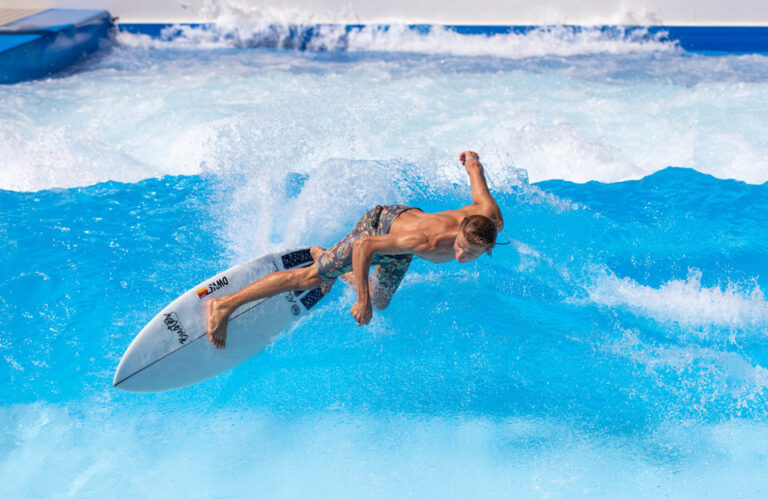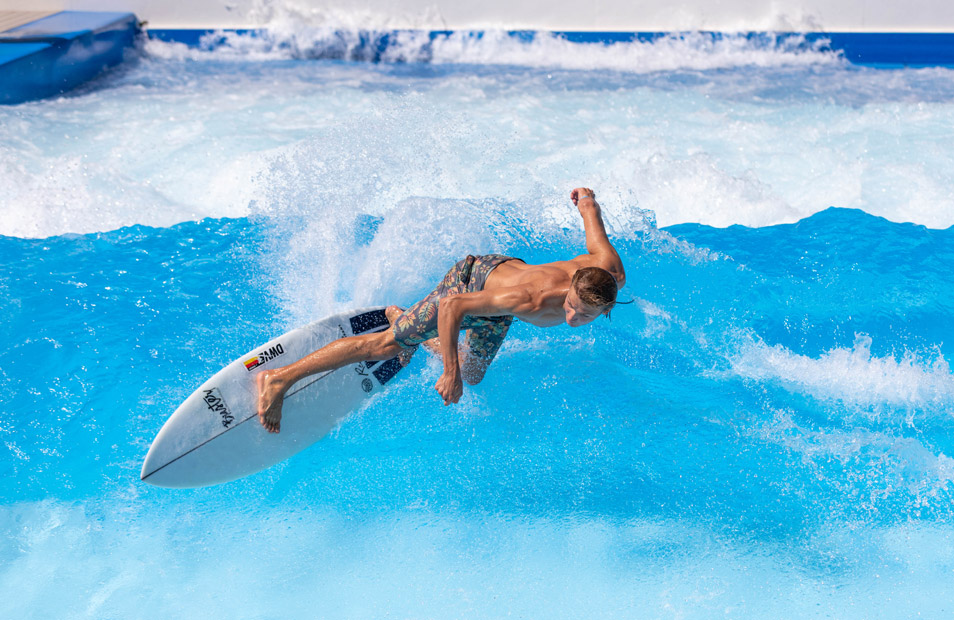
If you often surf waves of the Citywave type (e.g. in Munich, Vienna, Berlin, Osnabrück, Düsseldorf, Vilnius), you will quickly reach the limits of the softboards rented there. Due to the soft fins and the rather thick rails, you have to compromise on the performance of the rental boards. Especially light surfers find it more difficult to ride in a controlled manner on the rental boards due to the large tail area.
Which surfboard shape do I need for the Citywave?

On our Pool / Riversurfboards starting page you can view the range of use for each surfboard by clicking on the surfboard’s range link. The Citywave falls into the category of a “powerful wave”. Now you can see which surfboard suits you based on your weight. If several surfboards match your weight, you can read the details for which riding style this surfboard shape is best suited. Basically, the recommendations only apply to advanced to very good surfers.
For all Citywave surfers at Wellenwerk (Berlin), RheinRiff (Düsseldorf) or Irie Surf (Freiburg), there is another special feature: Surfers who mainly ride the wave in the “Pro” or “Big Wave” setting can add 5-10 kg to the recommended weight, as the wave there is more powerful than the other Citywave installations e.g. in Germany, Austria and Switzerland.
Pool & Riversurfboards overview
Contents
- The advantages of performance surfboards
- Differences in performance surfboards
- High tech for the Citywave
- Fins for the Citywave
What advantages do performance surfboards offer?
The outline, rocker and volume of fiberglass laminated surfboards specially shaped for Citywave waves are tailor made for these waves. This makes you more agile, allows you to surf turns more radically and learn tricks faster. Due to thinner rails the boards can be edged up more in turns, allowing you to surf tighter and at higher speeds. The surfboards are also significantly lighter and stiffer.
Differences in performance surfboards
While foam boards with soft fins are almost indestructible on waves of the Citywave design, damage can occur on the higher quality performance surfboards. But here too, there are differences in how sensitive the surfboards are.
Damage to the laminate on the rails and on the nose is possible if you make heavy contact with the wall at these points. High-quality surfboards are usually also ridden with harder fins to provide better control at higher speeds and in turns. These fins can break off if the surfboard gets stuck in the outflow during the exit or if you hit the wall during a turn. If things go particularly bad, or if you use the wrong fins, the fin boxes can also be damaged.
To reduce the risk of such damage to high-quality performance surfboards, Buster Surfboards has developed its own technologies.
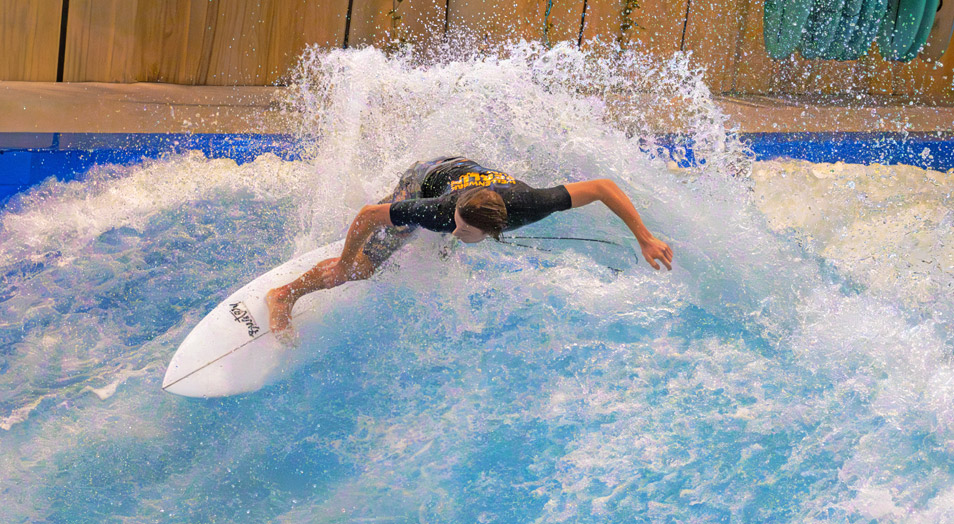
High tech for the Citywave
The Pool & Riversurfboards from Buster Surfboards in Classic construction are equipped with rail and nose reinforcement and are therefore more stable than normal surfboards when in contact with the wall.
All Pool & Riversurfboards from Buster Surfboards are equipped with special, xtra firmly laminated SANE fin plugs (FCS I system) with a particularly long base to minimize damage to the fin plugs or FCS II Plugs with HD Foam insert.
We have developed a special shape in collaboration with the Citywave Team Munich for surfers who are looking for the best performance for Citywave waves and surf at expert level. The P-Type is our first shape developed exclusively for the Citywave and for maximum performance. Our K-Type shape is ideal for girls & groms. For surfers who do not yet have expert skills, the G-Type and T-Type are very good boards with particularly stable handling. The C-Type is also a good alternative for slightly heavier surfers with good surfing skills. 2026 we’ve introduced a new shape “Slasher”. The Slasher is a competition shape for the powerful 2nd Gen Citywaves (like Berlin, Düsseldorf & Freiburg).
Pool & Riversurfboards overview
We offer our pool & riversurfboard shapes in different constructions. All shapes are available in the “Classic” construction, some of them in the “Featherlight” or “Ultra Series” construction.
Important: the right fins
For side fins, it is best to use inexpensive (accessory) fins with the FCS I system. Fin boxes with the FCS II system can be converted for use with FCS I fins. Under no circumstances should you use glass or carbon fiber reinforced side fins on the Citywave, as the fin box is often damaged before the fins break off. Damaged fin boxes are more difficult to repair. For the center fin we recommend to use a small 2.6″ fin with a special template designed for riversurfing and Citywave surfing (available at Buster Surfboards).
Featured photo: (c) flohagena.com